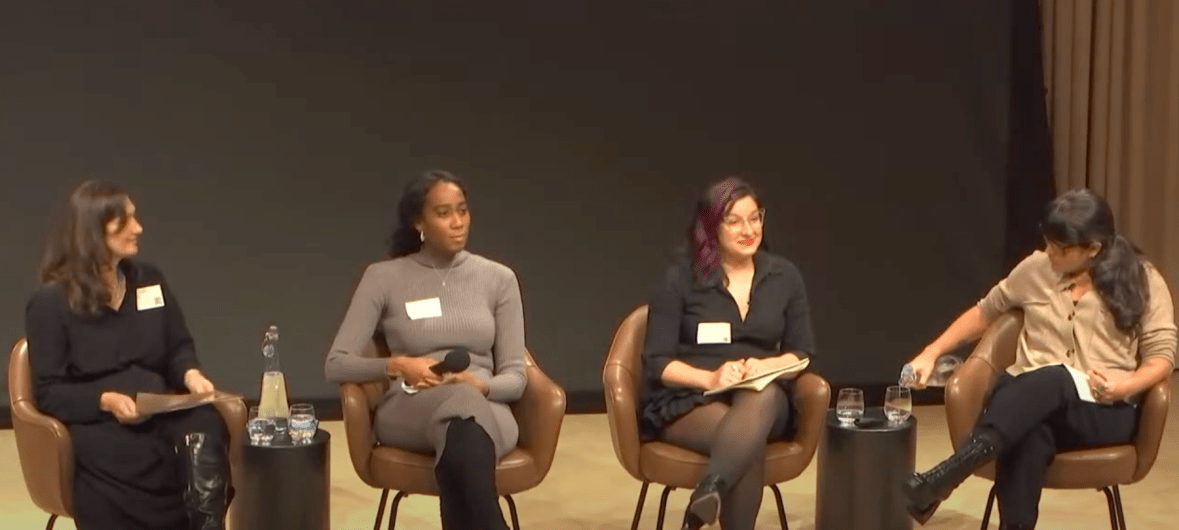
As a scholar of inequality in organizations, I am inspired to use my research to create actionable change in a variety of community engaged settings. Because of my expertise in gender inequality and the arts, I work with ArtTable, a prominent professional organization dedicated to promoting women and non binary workers in the visual arts, to develop a survey to better understand the lived experiences of arts workers. 1200 respondents completed the survey, and I am currently preparing several white papers reporting the results and offering policy recommendations to relevant stakeholders. In addition to these publications, I also have presented preliminary and developing results to a variety of ArtTable audiences, including to the local New York City chapter and as part of a broader national initiative (you can find a recording of the event here). This work focused on the study of gender inequality in the artistic labor market has allowed me to engage cultural policy audiences with my work, including a working paper with Dr. Jennifer Novak-Leonard using American Community Survey data to better understand the persistence and prevalence of the motherhood penalty and fatherhood benefit in female-dominated arts professions.
In addition to this work related to gender inequality in the arts, I was invited to collaborate with MetroArts Nashville in the development and execution of the curriculum for the 2021-22 Racial Equity in Arts Leadership program. Leveraging my knowledge of racial inequality and the arts, I provided guidance and pedagogical consultation to the government stakeholders at MetroArts and the arts leaders in Nashville selected as members of the 2021-22 REAL cohort. Through REAL, I used empirical findings to abstract to local policy changes and gained new insight and data into the ways in which local arts leaders develop networks of information sharing and practice to better understand and address racial inequality in elite artistic spaces and community arts organizations.
Similarly, my skills as an organizational ethnographer and scholar of race and organizations, especially higher education organizations, have allowed me to think about the enactment and effectiveness of diversity initiatives. While I was a provost’s postdoctoral fellow at New York University from 2018-2020, I developed research agendas for the Center for Faculty Advancement in the provost’s office, offering guidance for data collection and analysis designed to better understand faculty experience, recruitment, and retention, especially among faculty of color. Currently, I continue to collaborate with the CFA on data collection and analysis related to diversity initiatives, especially cluster hiring, and develop evidence-based programmatic responses to faculty engagement and development, especially for those faculty who represent populations historically underrepresented and excluded from the academy. In Spring 2023, I was invited to present some of this programming as part of the 2023 NYU Scholars Convention, an event reconvening scholars at various career stages who have participated in NYU’s diverse faculty advancement initiatives, including predoctoral programs (Faculty First Look), postdoctoral programs, and pre-tenure and tenured faculty. As a consultant, I have written multiple internal reports used to inform policy and practice at NYU and, through community information sharing, other universities with similar programs.
Finally, I am interested in ensuring that my work is relevant to an audience beyond the academy. As such, I promote my research in public-facing venues and think carefully about the ways in which my work can inform diners’ and industry professionals’ practices. In the last calendar year, I have participated in podcasts, such as the Conversation, public lectures for various audiences, including seniors at the 92nd St Y and high school students in New York City. My research agenda is informed by a desire to further sociological inquiry, especially through theory development, educate and excite a curious public, and shape actionable policy and practice interventions in a variety of organizational settings.
 Gillian D Gualtieri